
Thinking About Buying a Florida Home? What Amendment 3 Could Mean for Homebuyers in 2026
If buying a home in Florida is already part of your plans, 2026 could be an important year to understand Florida’s proposed property tax changes.
A proposed constitutional amendment, known as Amendment 3 - “Increased Homestead Exemption; Lower Cap on Increases in Non-Homestead Property Assessments” - will appear on Florida’s November 3, 2026, General Election ballot. If approved by at least 60% of voters, the amendment would change the homestead exemption available to qualifying Florida homeowners beginning in 2027.
One of the most important parts for people considering a move to Florida is a provision tied to Florida residency as of December 31, 2026.
What Would Amendment 3 Change?
Under current Florida law, qualifying homeowners can receive a homestead exemption that reduces the taxable value of their home by up to $50,000. The first $25,000 applies to all property taxes, while the additional exemption applies to non-school property taxes.
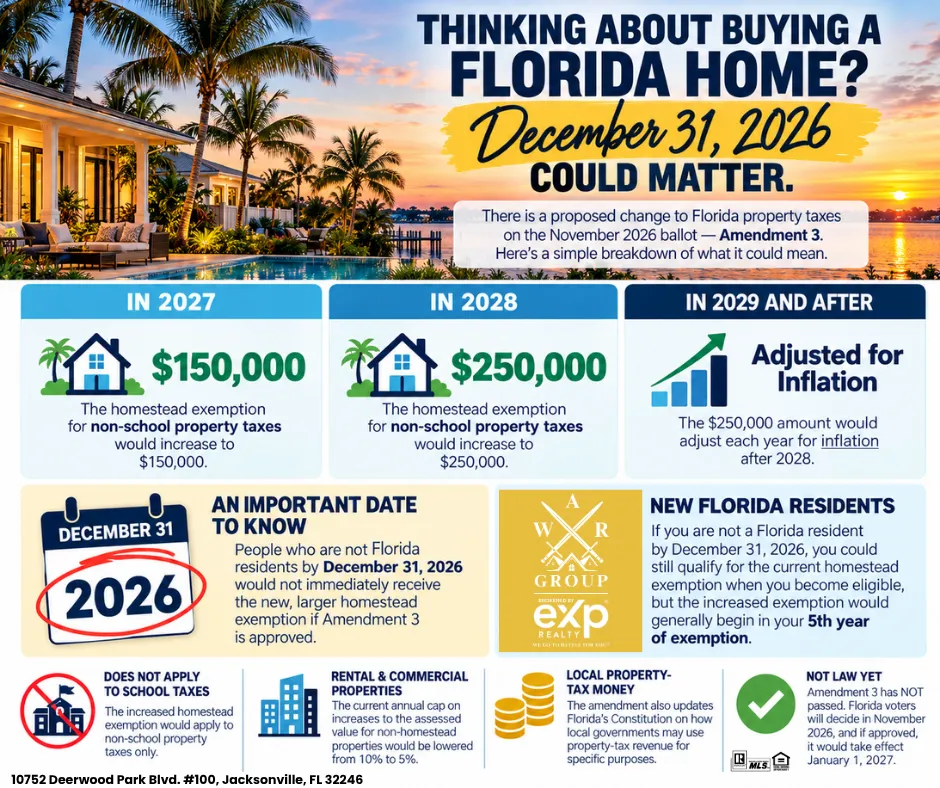
Amendment 3 would increase the exemption for non-school property taxes in stages:
January 1, 2027: Up to $150,000
January 1, 2028: Up to $250,000
Beginning in 2029: The $250,000 amount would be adjusted annually for positive inflation.
The amendment would not apply this increased exemption to school district property taxes.
It's also important to understand that an exemption reduces the taxable value of a property. It does not reduce the property's assessed value or automatically mean a homeowner's total property tax bill will fall by a particular dollar amount. Actual property taxes also depend on applicable millage rates and other assessments.
The December 31, 2026 Date Matters
This is where the proposed amendment becomes particularly relevant for people planning a move to Florida.
The proposed constitutional language distinguishes between people who maintained a permanent residence in Florida on or before December 31, 2026 and people who establish Florida residency after that date.
Under the proposal, someone who had not maintained a permanent residence in Florida as of December 31, 2026, could still qualify for the existing homestead exemption when they establish a qualifying Florida homestead.
However, the proposed amendment would generally delay access to the increased exemption until the fifth year of the homestead exemption for those new Florida residents.
In other words, simply purchasing a Florida home after January 1, 2027, would not necessarily mean receiving the full increased exemption immediately.
A simplified example
Suppose someone moves to Florida after December 31, 2026, purchases a home and establishes it as their Florida homestead.
If the amendment is approved, that homeowner would initially receive the applicable existing exemption rather than immediately receiving the full $150,000/$250,000 increased exemption. Under the proposed language, the increased exemption would become available beginning with the homeowner's fifth year of exemption, subject to the amendment's requirements.
The exact timing can depend on when the homestead exemption is established, so buyers should confirm their individual circumstances with their county property appraiser.
Does This Mean You Have to Buy a Home Before December 31, 2026?
Not necessarily.
This is an important distinction.
The proposed amendment does not simply say that everyone who closes on a Florida home by December 31, 2026, gets the larger exemption. The language focuses on whether a person maintained a permanent residence in Florida as of December 31, 2026.
For someone already living in Florida, establishing or maintaining a qualifying homestead is a separate issue from simply owning property.
For someone moving to Florida from another state, the timing of establishing Florida residency and homestead status could therefore be important.
That's why anyone considering a move should look at their individual circumstances rather than assuming that a particular closing date automatically guarantees a specific tax benefit.
What If You're Already a Florida Homeowner?
If you already have a qualifying Florida homestead exemption and Amendment 3 is approved, the proposed increase would generally apply to qualifying homestead property beginning with the 2027 tax year.
The current proposal would increase the non-school portion of the exemption to $150,000 in 2027 and $250,000 in 2028.
The Florida Department of Revenue recommends that property owners work with their county property appraiser for questions about individual exemptions and eligibility. The property appraiser determines whether a particular parcel qualifies for an exemption.
What Should Potential Florida Homebuyers Do Now?
If you're already considering purchasing a Florida home, this is a good time to understand the rules and how they could apply to your situation.
Here are a few things to consider:
1. Know your intended timeline
If you are planning to relocate to Florida in 2026 or 2027, talk through your timeline with your real estate professional and other appropriate professionals.
2. Understand Florida homestead requirements
Homestead exemption eligibility is based on specific requirements, including ownership and using the property as your permanent residence. The Florida Department of Revenue provides the official application and requirements.
3. Don't assume the exemption equals your tax savings
The proposed exemption applies to taxable value, not directly to the final tax bill. Your actual tax liability depends on the applicable tax rates and other assessments.
4. Check with your county property appraiser
Property tax administration is handled locally. The Florida Department of Revenue specifically directs homeowners to their county property appraiser for local information and exemption applications.
5. Discuss your situation with the appropriate professionals
A Realtor®, lender and qualified tax professional can help you evaluate your homebuying timeline, financing and potential tax considerations. A tax professional can also help you understand how Florida residency and homestead rules apply to your individual circumstances.
Remember: Amendment 3 Has Not Passed Yet
This is perhaps the most important part.
Amendment 3 is a proposal, not current Florida law. Florida voters will decide the measure on November 3, 2026, and a constitutional amendment requires approval from at least 60% of voters to become part of the Florida Constitution.
If approved, the amendment would take effect January 1, 2027.
Until then, Florida's current homestead exemption rules remain in effect.
So if you're thinking about buying a home in Florida before 2027, don't make a purchase decision based solely on a proposed tax change. Instead, understand the current rules, the proposed changes, your potential residency timeline and how the rules could apply to your specific situation.
Thinking About Buying a Home in Florida?
If a Florida move is already on your radar, now is a good time to start the conversation.
Whether you're relocating to Northeast Florida, Southeast Georgia, or another part of the state, understanding your timeline before you start shopping can help you make informed decisions about the homebuying process.
Thinking about buying before 2027? Let's talk about your timeline and what you should know before you make your move.
Official Resources
Florida Department of State - Constitutional Amendments: Florida Department of State: Constitutional Amendments & Initiatives
Florida Department of State - Amendment 3 details: Official Amendment 3 Information
Florida Department of Revenue - Property Tax Exemptions: Florida Department of Revenue: Property Tax Exemptions
Florida Senate - 2026 Amendment Information: Florida Senate: Amendment 3 Details
